

Brake-specific fuel consumption (BSFC) relates fuel mass flow to the mechanical power an engine delivers. It is commonly expressed in grams per kilowatt-hour (g/kWh). It helps compare operating points when the measurement conditions and the boundary of the system are clearly stated.
The BSFC formula and correct units
BSFC (g/kWh) = fuel mass flow (g/h) ÷ mechanical power (kW).
A kilowatt (kW) is a unit of power; a kilowatt-hour (kWh) is a unit of energy. They are not interchangeable with kW/h. An engine delivering 2 kW for one hour supplies 2 kWh of mechanical energy. At a BSFC of 300 g/kWh, its fuel consumption at that operating point would be 600 g/h.
A worked fuel-consumption example
The following numbers are an arithmetic illustration, not a Löweheiser product test or guaranteed consumption figure.
- A measured volume of 20 mL in 30 seconds corresponds to 2.4 L/h.
- Using an illustrative fuel density of 0.76 kg/L gives 1.824 kg/h, or 1,824 g/h.
- If measured mechanical output is 5 kW, BSFC is 1,824 ÷ 5 = 364.8 g/kWh.
Use the density applicable to the actual fuel and measurement conditions. A density in kg/L converts a volume into a mass; kg/h would instead describe a mass flow.
Why an operating map is more useful than one number
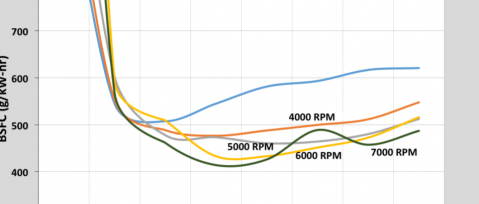
BSFC varies with operating point. Record engine speed and measured output, along with fuel, calibration, temperature and test configuration. A throttle percentage does not by itself establish output, and there is no universal throttle setting that represents cruise for every UAV.
A map or a set of repeatable measurements can show how consumption changes across the intended operating range. The chart retained below belongs to the original article; it should not be read as a current specification for every engine in the catalogue.
Mechanical engine output and electrical generator output are different
When evaluating a generator, specify whether the denominator is engine shaft power or delivered electrical power. Generator and conversion losses make those boundaries different. Label an electrical fuel-consumption result accordingly rather than comparing it directly with an engine BSFC figure.
What to include in a useful test record
- Engine model, hardware configuration, fuel and ECU calibration.
- Speed, load and the method used to determine mechanical output.
- Fuel measurement method, duration and instrument information.
- Ambient conditions and whether readings are steady or transient.
- Repeated measurements and relevant uncertainty or variation.
Browse EFI engines or hybrid drone generators, and ask for data relevant to your intended operating point.
Discuss your application
Send us your engine model, intended fuel, operating requirements and available installation details. Discuss your configuration with Löweheiser.
 English
 French
 German